McMurphy sees through the group meeting's attack on Harding
One Flew Over the Cuckoo's NestRandle Patrick McMurphy sees through the group meeting’s attack on Dale Harding and identifies its hidden structure: the patients are being drawn into weakening one another under the appearance of treatment. As the group turns Harding’s marriage and sexual insecurity into a public case, McMurphy names the process a pecking party and points to Nurse Ratched as its instigator. The intervention gives Harding language for a fear he says the patients share, and makes the meeting’s power dynamics visible to the group.
The Meeting Turns Harding into a Case
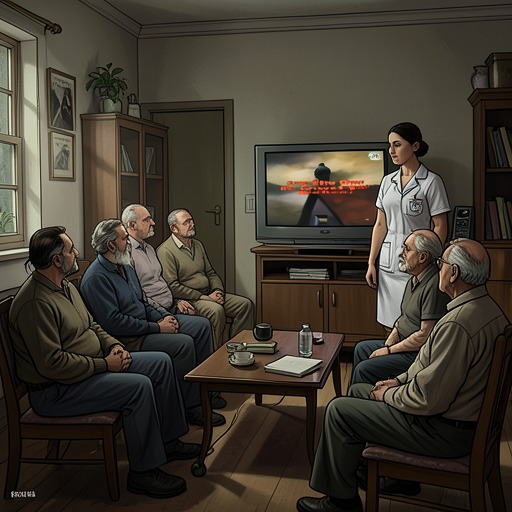
Nurse Ratched introduces the subject by reopening the record of an earlier Friday meeting. The logbook is marked with slips of paper, and the allegations she reads are attributed to notes made by various patients. They concern Harding’s comments about his wife’s body, his discomfort with the attention she attracts, and his own feelings of inferiority. The discussion is framed as an opportunity to address his problem, but the record also makes private statements available for collective scrutiny.
When Nurse Ratched asks whether anyone wants to pursue the subject, Harding shuts his eyes and the others remain silent. McMurphy, sitting apart in an armchair with a deck of cards in his lap, watches the room rather than joining in. The men avoid meeting the nurse’s gaze. The silence and their withdrawn attention form the setting for what follows: Harding is exposed, while the other patients wait to see what response is safe.
The examination does not end with the nurse’s reading. At two o’clock, after about forty-five minutes of questions and insinuations, the patients have pressed Harding on his marriage, his suspicions, and whether his answers show that he can get well. The Acutes, who had been drawn into questioning him as though they were prosecutors and judges, look ashamed when the meeting breaks. Some fetch tables; others turn to magazines. Their activity keeps them from having to face the man they have just helped isolate.
McMurphy Names the Pecking Party
McMurphy does not interrupt the meeting itself. He watches the patients’ discomfort, then leaves his chair, takes a wooden chair over to Harding, turns it backward, and straddles it. He lights a cigarette and begins by asking whether the meetings usually proceed this way. Harding is at first still humming and staring past him; when he turns, he tries to recover a relaxed posture. McMurphy’s casual manner makes the accusation that follows harder to dismiss as a formal argument.
He compares the meeting to a flock of chickens attacking one bird after a spot of blood draws their attention. The violence spreads as more birds are marked and become targets in turn; the flock can destroy itself. McMurphy explains that the meeting has reminded him of this process, then identifies Nurse Ratched as the one who begins the first peck. The image converts the group’s apparently individual questions into a pattern: patients are induced to participate in an attack whose consequences can pass from one vulnerable person to the next.
Harding objects that McMurphy has reduced complex therapeutic work to a crude analogy, invoking Freud, Jung, and Maxwell Jones. McMurphy does not try to compete with Harding’s theoretical language. Instead, he asks whether the day’s meeting is actually doing anyone good or bringing about a cure. Harding answers that the staff must want the patients’ recovery, and resists the suggestion that Nurse Ratched is simply a monster. McMurphy’s reply distinguishes literal violence from the meeting’s subtler injury: the nurse is not pecking at their eyes.
From Group Scrutiny to Shared Fear
McMurphy makes the metaphor bodily and confrontational, describing Nurse Ratched’s method as cutting at the patients’ strength so that they will yield to rules and live as others require. The language is deliberately coarse, but its point is about power: a person can be made compliant by being weakened at the place where he feels most vulnerable. In the context of Harding’s public humiliation, the metaphor exposes how discussion of personal problems can become a means of control rather than care.
Harding’s response shows the cost of hearing this said aloud. He tries to grin, but his face is pale; he takes a cigarette McMurphy offers him, and his twitching gradually slows. He then tells McMurphy that he is right and looks toward the other patients, saying that no man among them is untouched by the same fear. His acknowledgment changes the exchange from a private conversation between two men into a recognition of shared experience. McMurphy’s intervention does not solve their situation, but it breaks the isolation that allowed the attack to pass as ordinary procedure.
Harding also explains why the ward’s doctor does not simply stop Nurse Ratched. In his account, Dr. Spivey knows his own inadequacy and depends on her to run the ward. She knows that he knows it, Harding says, and uses mistakes in paperwork or charting to remind him of that dependence. The account widens McMurphy’s analogy beyond the patients’ meeting: the ward’s power is sustained not only by direct authority but by relationships in which people anticipate correction and feel unable to act independently.
The Later Significance of Visible Dissent
The episode gives the patients a way to recognize what is happening when fear makes opposition hard to express. That difficulty appears again when McMurphy proposes changing the schedule so they can watch the World Series. At first, the Acutes do not answer him, and when a vote is called Cheswick’s hand is the only one to rise. The silence recalls the earlier meeting’s pressure to remain withdrawn, even when the patients have a shared interest at stake.
In a later vote on the same change, McMurphy raises his bandaged hand first. The other hands follow until all twenty Acutes are standing with their hands raised. Chief Bromden narrates the gesture as McMurphy drawing the men up out of the fog, one after another. Their vote concerns television time, but it also registers opposition to Nurse Ratched’s treatment of McMurphy and to the way she has worn them down. The contrast with the earlier silence shows that the group’s compliance is not proof of agreement: visible action by one patient can make collective refusal newly possible.
Narrative and Thematic Role
Chief Bromden’s account connects the meeting’s ordinary details—the logbook, the questions, the cigarette, the chairs—to a larger image of reciprocal destruction. The pecking-party analogy matters because it refuses to treat the patients’ participation as harmless merely because it occurs within a therapeutic routine. The men help attack Harding, then feel shame and avoid him; the procedure turns the group into both the instrument and the audience of his exposure.
McMurphy’s response also marks a shift in what the patients can say about Nurse Ratched. Harding moves from defending the stated purpose of treatment to acknowledging the fear shared by the ward. The later vote gives that recognition a public form. Together, the scenes show how McMurphy’s blunt naming of coercion can interrupt patient-on-patient scrutiny and help transform private resentment into collective dissent.